
Table of Contents
- The question everyone asks but nobody answers straight
- IPTV technology itself is legal
- Where the legal line gets blurry
- How to tell if an IPTV provider is legitimate
- Risks of using an unlicensed IPTV service
- Legal IPTV alternatives worth considering
- What the law says in the United States
- Final thoughts
I cannot tell you how many times someone has pulled me aside at a barbecue or sent me a text asking the same thing. “Hey Alex, is this IPTV stuff actually legal?” And every single time my answer starts the same way — it depends.
I know that is not the definitive yes or no answer people want to hear, but it is the honest truth. The technology behind IPTV is perfectly legal. The way certain providers use that technology is where things start getting complicated. And if you are going to spend your hard-earned money on a service and stream it in your own home, you deserve to understand exactly where the legal boundaries are before you commit.
I am not a lawyer. Let me be real clear about that. But I have spent a good amount of time researching this topic because I wanted to make sure I was not putting myself at risk, and I figured I owe the same transparency to anyone reading this. So let me lay it all out as plainly as I can.
IPTV technology itself is legal
Let me get this out of the way right up front. IPTV as a technology is completely legal. There is nothing illegal about delivering television content over the internet. Major companies use IPTV every single day.
When you watch something on YouTube TV, Hulu Live, Sling TV, or FuboTV, you are technically using IPTV. These services deliver live television channels and on-demand content through your internet connection, which is the exact definition of internet protocol television. They just do it under properly licensed agreements with content owners and broadcasters.
So the technology is not the issue. The issue is licensing. The question is not whether IPTV itself is legal — it is whether the specific provider you are using has the legal right to distribute the content they are offering.
Think of it like this. Selling DVDs is legal. Selling bootleg copies of movies you do not own the rights to is not. The format is fine. The source matters.
Where the legal line gets blurry
Here is where things get a little muddier, and I want to be straight with you about it because I think a lot of people genuinely do not realize where the line is.
There are hundreds of IPTV providers out there, and a significant number of them operate without proper licensing agreements. They offer thousands of live TV channels and massive movie libraries at prices that seem too good to be true — sometimes as low as three to five dollars a month. That pricing should raise a red flag immediately.
Licensing content from networks like ESPN, Fox, HBO, and others costs real money. When a provider offers you five thousand channels for pocket change, they are almost certainly not paying licensing fees for that content. They are rebroadcasting streams they do not have the legal right to distribute.
These unlicensed providers exist in a legal gray area that is increasingly becoming less gray and more definitively illegal. Authorities in the United States and internationally have been cracking down on illegal IPTV operations with increasing frequency over the past few years. Services that seemed untouchable have been shut down overnight, leaving their subscribers with nothing — no service, no refund, no recourse.
The tricky part for consumers is that these unlicensed services often look just as professional as legitimate ones. They have polished websites, customer support channels, social media pages, and apps that work smoothly. From the outside, it can be genuinely difficult to tell the difference between a licensed provider and one that is operating outside the law.

How to tell if an IPTV provider is legitimate
Since the line between legal and illegal providers is not always obvious, here are the specific things I look for when evaluating whether a service is operating within the law.
Transparent business information. A legitimate provider will have a real company name, a physical address or registered business location, and clear contact information. If the only way to reach a provider is through a random Telegram channel or a Gmail address, that is a warning sign.
Reasonable pricing. Licensed content costs money to distribute. If a provider is charging ten to twenty-five dollars a month for a reasonable selection of channels and VOD content, that is within the range of what a legitimate service might charge. If they are offering everything under the sun for three dollars a month, someone is not getting paid — and it is the content creators.
Available on official app stores. Legitimate IPTV apps are typically available on the Google Play Store, Apple App Store, or Amazon App Store. If a provider requires you to sideload their app from an unknown website and cannot be found on any official platform, proceed with caution.
Clear terms of service. Real companies have real terms of service, privacy policies, and refund policies. Read them. If a provider does not have any legal documentation on their website, or if the terms are vague and full of copied boilerplate text, that is not a great sign.
Verifiable user reviews. Look for reviews on independent platforms — not just testimonials on the provider’s own website. Check Reddit, Trustpilot, or tech forums for real user experiences. Legitimate services tend to have a longer track record and a more consistent presence in user communities.
No single one of these factors is a guaranteed indicator on its own, but when you stack them together they paint a pretty clear picture of whether a provider is operating above board.
Risks of using an unlicensed IPTV service
I want to be honest about this because I think it is important for people to understand what they are potentially getting into.
Service shutdowns. Unlicensed IPTV services get shut down. It happens regularly. When a service goes dark, you lose access immediately with no warning. If you paid for a six-month or annual subscription upfront, that money is gone. There is no customer service line to call and no refund process to follow. The service simply stops existing.
Legal consequences for users. While enforcement efforts have historically focused on the providers themselves rather than individual users, the legal landscape is evolving. In some countries, users of unlicensed streaming services have received warning letters or fines from internet service providers acting on behalf of copyright holders. In the United States, the risk to individual users has been relatively low so far, but that does not mean it will stay that way.
Malware and security risks. Some unlicensed IPTV apps require you to sideload software from unverified sources. These apps can contain malware, spyware, or other malicious code that compromises your device and personal information. Even if the app itself is clean, the websites hosting the downloads may not be.
Inconsistent quality. Unlicensed services do not have the infrastructure or server capacity that legitimate operations invest in. Streams frequently buffer, channels go offline without explanation, and customer support is often unreliable or nonexistent. You might get a great experience one week and a terrible one the next.
Ethical considerations. This one is more personal, but it matters to me. The people who create the movies, shows, and sports broadcasts we enjoy deserve to be compensated for their work. When we use services that distribute their content without permission or payment, those creators lose revenue. I am not trying to preach here, but it is something worth thinking about.
Legal IPTV alternatives worth considering
If you want the IPTV experience without any legal concerns, there are legitimate services that deliver live TV and on-demand content through internet protocol and operate with full licensing agreements.
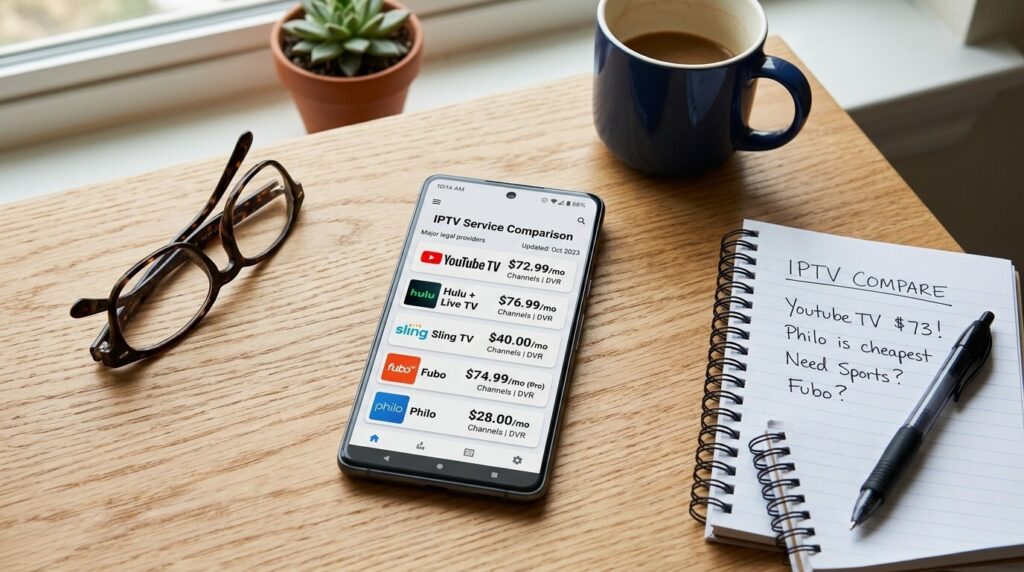
YouTube TV offers over 100 live channels including major sports networks, local channels, and a cloud DVR. It runs about 73 dollars a month, which is not cheap, but it is fully licensed and reliable.
Hulu with Live TV combines Hulu’s on-demand library with over 90 live channels. Pricing starts around 77 dollars a month. It is a solid option if you want both live sports and a deep on-demand catalog.
Sling TV is one of the more affordable legitimate options, starting around 40 dollars a month. It offers fewer channels than YouTube TV or Hulu Live but covers the essentials — ESPN, Fox, NBC Sports, and a good selection of entertainment channels.
FuboTV is built specifically for sports fans and carries a wide range of sports networks including international football channels. Plans start around 75 dollars a month.
Philo is the budget-friendly choice at around 25 dollars a month, but it does not include sports or local channels. It is a good fit for people who mainly watch entertainment, lifestyle, and news content.
These options cost more than unlicensed IPTV services, no doubt about it. But they come with legal peace of mind, reliable performance, proper customer support, and the knowledge that the content creators are being fairly compensated.
What the law says in the United States
Copyright law in the United States protects the rights of content creators and distributors. Under the Digital Millennium Copyright Act, commonly known as the DMCA, it is illegal to circumvent copyright protections or to distribute copyrighted material without authorization.
For IPTV providers, this means distributing live TV channels or on-demand content without licensing agreements violates federal law. Providers who get caught face criminal charges, heavy fines, and imprisonment in some cases. The Department of Justice and the FBI have both been involved in shutting down large-scale illegal IPTV operations in recent years.
For users, the legal situation is less clear-cut but still worth understanding. Watching a stream from an unlicensed source is technically a copyright infringement, though enforcement against individual viewers has been rare in the US. Most legal action targets the providers and distributors rather than the end users.
That said, the trend is moving toward greater enforcement across the board. Internet service providers in the United States have sent warning notices to customers whose IP addresses were detected accessing illegal streaming services. While these warnings have generally not resulted in legal action against individual users so far, they signal a shift in how seriously authorities and ISPs are taking the issue.
My personal take — it is just not worth the risk. The savings from using an unlicensed service are not significant enough to justify the potential headaches, whether those headaches come in the form of a sudden service shutdown, a warning letter from your ISP, or worse.
IPTV technology is legal. Using a licensed IPTV service is legal. The problems start when providers distribute content they do not have the rights to, and when users knowingly access that content.
If you decide to use IPTV — and I think it is a great option when done right — take the time to verify that your provider operates within the law. Look for transparent business information, reasonable pricing, availability on official app stores, and a solid reputation backed by independent reviews. If something feels off, trust your gut and move on to the next option.
There are legitimate ways to enjoy IPTV without looking over your shoulder, and the peace of mind that comes with doing things the right way is worth a few extra bucks a month.
If you are past the legality question and ready to figure out which option gives you the most bang for your buck, I put together a detailed comparison of IPTV vs cable vs streaming apps that breaks down costs, features, and value side by side. And for the full rundown on everything IPTV — from what it is to how to set it up and which providers to consider — the complete guide to IPTV service walks you through it all.
Stay smart out there and enjoy your content the right way. That is the Arizona way.